Ream Family History
The Ream family’s journey from Leimen, Germany, to Reamstown and Somerset County, Pennsylvania
It Starts with One Man
Every story on this page leads back to Johann Eberhardt Riehm (1687–1779), a German immigrant who crossed the Atlantic in the early 1700s and put down roots in Lancaster County, Pennsylvania. In America the name Riehm became Ream, and his descendants founded a town, fought in the Revolution, carried the family west over the Turkey Foot Road, ran a mill in the Somerset County hills and even sculpted Abraham Lincoln.
Leimen, Germany
Eberhardt was born on October 6, 1687, in Leimen, a vineyard town just south of Heidelberg in the Rhine Palatinate region of what is now Baden-Württemberg. The Palatinate had been ravaged by decades of war, French invasions, harsh winters and religious strife, and thousands of Palatine Germans left for Pennsylvania in the early 1700s, drawn by William Penn’s promise of cheap land and religious freedom.
Eberhardt married Anna Elisabeth Schwab around 1712, and their first children were born in Germany. Around 1717 the family set out for America. No surviving record names the ship they sailed on.

The old Franzosenturm (“French Tower”) in Leimen. Photo: Neq00, CC BY-SA 4.0
Pioneers on the Cocalico
By about 1724 the Riehms had pushed into the frontier along Cocalico Creek in northern Lancaster County, then wilderness at the edge of settlement. Eberhardt took out land patents from the Penn family in 1725 and 1734, was naturalized as a British subject in 1729, and raised eleven children: Jacob, Anna, Abraham, Nicholas, John, Mathias, Tobias, Andrew, Susanna, Samuel and Adam.
On February 15, 1759, the old pioneer divided most of his land among his seven living sons. He died in August 1779, in the middle of the Revolution, at about 92 years old. He is buried in Ream’s Cemetery, about half a mile southwest of the town his son founded.
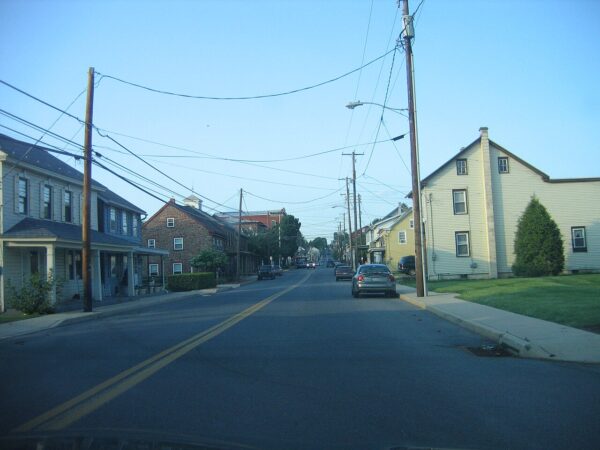
State Street, Reamstown. Photo: Andrew Bossi, CC BY-SA 2.5
Reamstown, Lancaster County
In 1760 Eberhardt’s son Tobias Ream (1733–1807) divided 54 acres of his share into building lots and laid out a village he called Zoar. The first deeds were handed over on September 24, 1761. In 1773 Tobias and his wife Juliana gave Lot 54 to trustees, one of them his brother Andrew, for a free school, a church and a burying ground. The Lutheran and Reformed church still stands on that lot.
The town went by several names. When the post office opened on January 1, 1803, it was called Rhemstown, and in 1810 it officially became Reamstown. In the local Pennsylvania German dialect it was Riemeschteddel. A state historical marker on East Church Street, dedicated at the town’s bicentennial in 1960, honors Eberhardt as the pioneer settler and Tobias as the founder.
A Revolutionary War Hospital
After the Battle of Brandywine on September 11, 1777, George Washington’s army fell back and its wounded were sent to towns across Lancaster County. Reamstown was one of them. Soldiers were cared for in the town’s barracks building, and those who died were buried together behind the church Tobias had given land for. Local accounts put the number between a dozen and about thirty. A boulder and bronze tablet placed in 1925 marks their resting place.
The Ream family served too. Eberhardt’s son Andrew Ream (1737–1813) was a captain in the 2nd Company, 3rd Battalion of the Lancaster County Militia. Family tradition also tells of a young drummer boy named Andrew Ream who beat the drum at the Battle of Monmouth in 1778.

“The Nation Makers” by Howard Pyle, showing Brandywine. Public domain
West over the Mountains: Captain Andrew and Ursina
In the 1780s Captain Andrew Ream left Lancaster County and took his large family west over the Alleghenies into what was then Bedford County and is now Somerset County. They settled in the Turkeyfoot country near present-day Ursina, close to where the old Turkey Foot Road crossed the Casselman and Laurel Hill Creek. Andrew died there on May 11, 1813.
He was laid to rest in the family burial ground on his own land.
The Ream Cemetery at Ursina
The family burial ground sits on Captain Andrew’s own land along Laurel Hill Creek, just below the village of Ursina in Lower Turkeyfoot Township. His tract, called “Long Bottom,” covered 286 acres near the mouth of Lick Run and was granted to him in 1787, the same year as the earliest known burial in the cemetery. The 1884 county history simply calls it “the old graveyard below Ursina.”
Who rests there. Captain Andrew Ream (1737–1813) and his wife Susanna (Fiesser) Ream; their son John Ream, who died in November 1839 and is buried near his first wife; that first wife, Anna Rosina (Weitzel) Ream, who died of a snakebite on July 15, 1792; their son Thomas Ream (1786–1840), the Draketown miller; and later family members, including John’s second wife, Catharine (Minerd) Ream, whose grave may now be lost. Family accounts say several Revolutionary War veterans are buried there as well.
The stones. Many of the oldest markers are lettered in German, and family tradition says Andrew carved some of them himself. Anna Rosina’s stone was carved by her son Samuel and decorated with a heart, crossed bones, a star, an angel and a snake, a nod to how she died. Its German epitaph records her years of marriage, and for a long time it was the largest marker in the cemetery.
Norman Ream’s wall. In 1911 Norman B. Ream, by then one of the richest men in America, paid to protect his ancestors’ graves with a cement wall around the cemetery. The work was carried out by the county surveyor, Colwell Seveno Younkin.
Vandalism and restoration. In 1991 and 1992 vandals destroyed about a dozen tombstones. The Ream Cemetery Association restored the grounds and built a new access road. In nearby Confluence, a memorial tablet honors John Ream, his father Captain Andrew Ream and Captain Benjamin Jennings among the area’s early settlers and soldiers.
Some details vary between sources. The 1884 county history gives Andrew’s death as 1818 rather than 1813, and records disagree slightly on John Ream’s birth year.
The Grist Mill at Draketown
Draketown, a small village in Lower Turkeyfoot Township, takes its name from Oliver Drake, who settled there around the time of the Revolution. About 1787 Drake built a small grist mill, along with a sawmill and a woolen mill. His son Jonathan built a new mill on the same site in 1812. It burned a few years later and was rebuilt around 1819.
Andrew’s grandson Thomas Ream (1786–1840) moved to Draketown with his family when he was about four, and the 1884 county history says he “ran the old gristmill at Draketown.” His life ended suddenly in February 1840, when he was struck by a falling tree, or a falling limb in some accounts, on his way home. The sale of his estate listed bearskins, buckwheat bakers and a German Bible, a glimpse of a Pennsylvania German household on the frontier.
His son Thomas Ream Jr. (1819–1885) was born in Draketown and was listed as the village’s flour miller in 1850. The Somerset Herald praised his flour in 1878. He served as justice of the peace for more than twenty years and organized a Blaine and Logan rally in Draketown during the 1884 presidential campaign. He is buried at the Jersey Baptist Church cemetery near Ursina.
A Famous Cousin: Vinnie Ream and the Lincoln Statue
Family historians count sculptor Vinnie Ream (1847–1914) among Eberhardt’s many descendants. As a teenager working in Washington during the Civil War, she persuaded President Lincoln to sit for her, and he posed in the White House for half-hour sessions over several months.
After the assassination, Congress commissioned a full-size marble statue of Lincoln in 1866. Vinnie, just 18, won it, making her the first woman to receive a federal art commission. Her statue was unveiled in the Capitol Rotunda in 1871 and still stands there today.


Vinnie Ream by G. P. A. Healy (Smithsonian American Art Museum) and her Lincoln statue in the U.S. Capitol. Both public domain


Norman B. Ream, and Ream with U.S. Steel’s Richard Lindabury, Percival Roberts and Elbert H. Gary. Library of Congress, public domain
From Harnedsville to Wall Street: Norman B. Ream, Carnegie and U.S. Steel
The most remarkable Turkeyfoot Ream may be Norman Bruce Ream (1844–1915). He was born on November 5, 1844, at Harnedsville, right on the old Turkey Foot Road, a great-great-grandson of Captain Andrew through Andrew’s son John B. Ream. As a teenager he joined the 85th Pennsylvania Infantry in the Civil War and rose from private to first lieutenant, reportedly the youngest man to make that jump, before wounds forced him out in 1864.
After the war he kept a store in Illinois and traded cattle and grain in Iowa, lost everything in a crop failure, paid back every debt, and moved to Chicago in 1877. There he made a fortune on the Board of Trade and became a trusted adviser to George Pullman, Marshall Field and J. P. Morgan. He helped reorganize the Baltimore & Ohio Railroad, the same line that runs along the Casselman River near his birthplace, and in 1898 he helped organize the National Biscuit Company (Nabisco) and the Federal Steel Company.
That is where Andrew Carnegie comes in. In 1901 J. P. Morgan bought out Carnegie’s steel empire, the largest in the world, and merged Carnegie Steel with Federal Steel and other companies to form United States Steel, the first billion-dollar corporation in history. Norman Ream, the boy from Harnedsville, sat on the new company’s board of directors and its finance committee, at the table that took over Carnegie’s mills.
By his death in 1915 he was worth an estimated $50 to $75 million, one of the 25 richest people in America. He never forgot the Turkeyfoot, though. In 1911 he paid for a cement wall around the Ream Cemetery at Ursina, where his ancestor Captain Andrew Ream lies buried.
The Ream Family Crest
The Riehm family of Leimen has its own family crest, and it has turned up on both sides of the Atlantic. It was photographed in 1966 at the Gasthaus Zum Bären, an inn in Leimen, and again in 2011 and 2013 at the Leimen home of Anton “Toni” Riehm, a present-day member of the German family. A version also hangs in the Ream Museum in Reamstown, the town Eberhardt’s son Tobias founded. American cousins have redrawn it twice, Mark Ream in 2002 and Tomas Manual Ream in 2026, so the old design can be reproduced cleanly.
The crest fits the family’s roots in Leimen’s vineyards. As the Ream family website reads it:
- The plants on the crest are likely grapevines, a link to the vineyards the Riehms tended around Leimen.
- The griffin-like creature may be a symbol of celebration after the grape harvest.
- The three round circles may be wine vats.
- The container beneath the cross may be a religious vessel for the bread and wine of Communion.
These readings are the family’s own interpretation. No record of an official grant of arms has been found, and the crest is best understood as a traditional emblem the Riehm family kept in Leimen and carried down through its American branch. You can see the photographs of the crest from Leimen and Reamstown, along with both redrawn versions, on the Ream Family Crest page of the Ream family history site.
Ream Places You Can Visit
Leimen, Germany
Eberhardt’s hometown, a short drive south of Heidelberg.
Reamstown Marker
The “Pioneer Settler / Founder of Reamstown” marker on East Church Street, East Cocalico Township, Lancaster County. Marker text
Ream Cemetery, Ursina
The burial ground of Captain Andrew Ream and generations of the Turkeyfoot Reams, near Ursina in Somerset County.
Draketown
The Lower Turkeyfoot village where the Reams ran the grist mill, near the Jersey Baptist Church cemetery.
Sources: the Reamstown historical marker (HMdb); Pierce Lesher, “Notes on Reamstown” (LancasterHistory, 1926); Ream Family History and The Riehm Family in Germany; Ream Family Crest; Mark Miner’s biographies of John and Catharine Ream, Thomas Ream Sr. and Thomas Ream Jr.; Draketown, 1884 History of Somerset County; SAR patriot record for Andrew Ream; Wikipedia; Norman Bruce Ream and Wikipedia on Norman B. Ream. Images via Wikimedia Commons: Heidelberg and the Neckar by Yair Haklai (CC BY-SA 4.0); Leimen by Neq00 (CC BY-SA 4.0); Reamstown by Andrew Bossi (CC BY-SA 2.5); Howard Pyle, G. P. A. Healy, Architect of the Capitol and Library of Congress (public domain).